Abstract digital graphic of a dark blue technology network with glowing cyan lines, circuit-like nodes, and several white and blue square blocks.

Build Clearer API Development Skills

A dark abstract digital background with glowing cyan lines, small 3D block shapes, and faint technical interface graphics and text.

Explore Courses

Shop all

Code With Purpose, Build With Structure

Our mission is to help learners develop API Development knowledge through clear explanations, organized modules, practical exercises, and visible workflows. Each course is designed to show how requests, data, validation, services, testing, and architecture connect within a structured application.

  • A black smartphone displayed upright on a small black stand against a plain white background. The phone screen shows a book cover with blue and black imagery and the title 'Pune Sagar'.
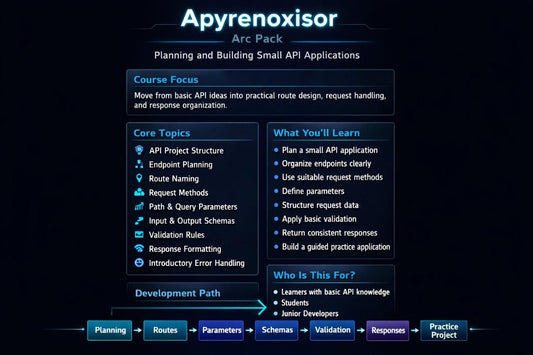
  • Top-down view of a person typing on a silver laptop with a black screen displaying a digital cover titled 'Arc Pack'.
  • A black tablet device centered on a white background, displaying a dark blue software or digital product cover titled 'Flux Bundle' on its screen.

30-days refund guarantee

Try the course completely risk-free. We want you to learn with total confidence, so if you’re not thrilled with the material for any reason, we’ll give you a full refund—no questions asked, no hassle. Simply submit your request within 30 days of purchase in accordance with our Refund Policy.

Created Around the Way Developers Learn

Apyrenoxisor began as a collection of route maps, architecture notes, validation examples, and development checklists created to make API concepts easier to follow. As these resources became more structured, our team developed them into a complete curriculum connecting foundational ideas with practical application planning.

  • Kellan Vossner - API Integration Engineer

    Kellan Vossner

    API Integration Engineer

    Kellan develops connections between separate API services and internal application components. He organizes outgoing requests, response validation, retry rules, and event-based communication. His work supports reliable information exchange across connected systems.

  • Orson Cade — API Testing Analyst

    Orson Cade

    API Testing Analyst

    Orson reviews route behavior, validation conditions and error responses through structured testing. He prepares test scenarios for expected and unexpected application conditions. His findings help development teams identify unclear behavior and revise technical components.

  • Zaylie Marlow — API Data Schema Specialist

    Zaylie Marlow

    API Data Schema Specialist

    Zaylie designs request, response, and internal data schemas for API applications. She defines field types, required values, validation conditions, and data relationships. Her work helps keep information structures organized across routes, services, and storage components.

Begin With a Free API Learning Resource

Start with an introductory Apyrenoxisor resource created for learners exploring the foundations of API Development. The material explains core terminology, request-and-response flow, endpoints, structured data, and introductory validation concepts. Clear diagrams, short exercises, and review notes provide a practical view of how the wider curriculum is organized. Download the free material and study it offline according to your own schedule.

  • A 3D isometric graphic showing four blue and cyan stylized looped shapes arranged around a central crossed arrow on a white background.

    Practical Learning

    Guided activities help learners apply technical ideas through route planning, data modeling, testing, and architecture exercises.

  • A 3D digital illustration of a network or data structure, featuring dark blue and purple stacked square blocks connected by lines to a central hub with cyan accents, set against a plain white background.

    Clear Structure

    Topics follow a logical sequence that connects foundational API concepts with broader development responsibilities.

  • A 3D digital icon of a glossy, rounded rectangular plate with a blue border, featuring a white document with blue lines and a blue checkmark, set against a plain white background.

    Focused Modules

    Each structured module explores a defined topic without combining too many unrelated development concepts at once.

  • A 3D digital illustration of a geometric network or molecular structure composed of six circular nodes in shades of blue, teal, and purple, connected by lines on a solid white background.

    Useful Resources

    Diagrams, worksheets, checklists, examples, and review materials support independent study and repeated practice.

  • LinkedIn logo on a white background
  • GitHub logo with a black circle and white cat-like face design
  • Black circle with a white letter 'M' in the center

Look Inside the Learning Structure

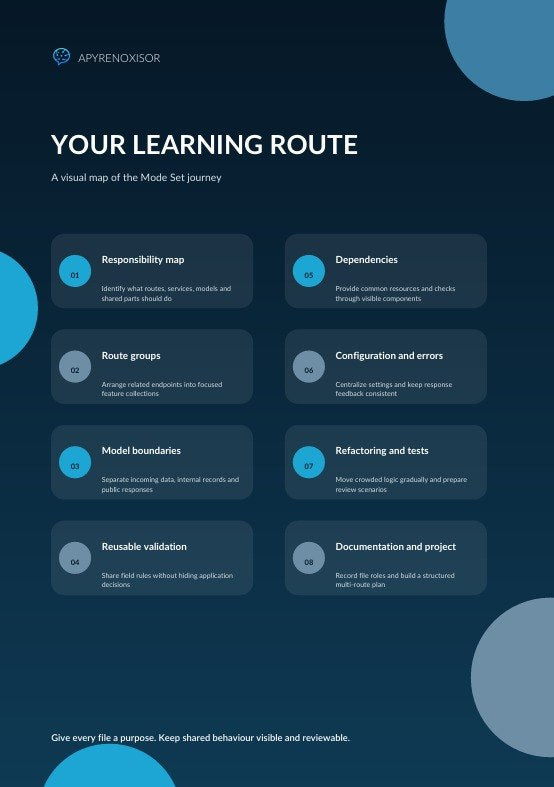
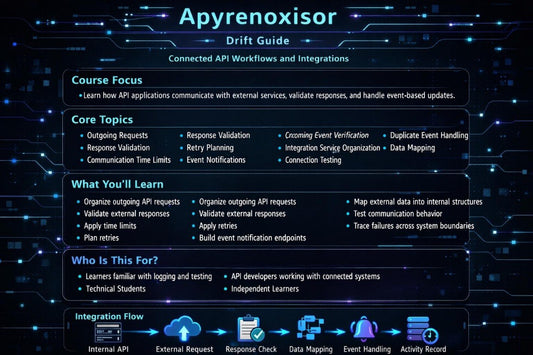
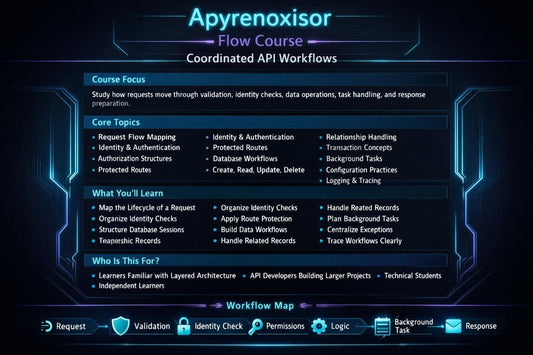
Explore the Apyrenoxisor course collection and review how each learning tier develops API Development knowledge in a structured sequence. The curriculum covers foundational concepts, endpoint planning, validation, application organization, testing, integrations, asynchronous workflows, and connected service architecture. Each course includes clearly arranged modules, practical examples, guided activities, and supporting resources for independent study. Select the Preview Courses button to compare the available tiers and examine their included topics.

  • Elodie Harper

    Elodie Harper

    Elodie began the course while exploring backend development and needed a straightforward introduction to technical terminology and application communication. The concise explanations, planning worksheets, and guided exercises helped her study routes, parameters, schemas, and validation in a logical order. “The course gave me a practical learning sequence that I could revisit whenever a concept needed further review.”

  • Callan Mercer

    Callan Mercer

    Callan had created several small endpoints but wanted a more structured way to organize services, data operations, and shared dependencies. The architecture examples and refactoring activities were useful because they showed how crowded files could be divided into focused components. “I appreciated that the materials explained the reason behind each structural choice instead of presenting code without context.”