Apyrenoxisor
Motion Series
Motion Series
Couldn't load pickup availability
- 📥 Digital file available after purchase
- 🗂️ Long-term availability
- 🔐 Secure checkout
- 🗓️ Content updated in 2026
Self-paced learning overview
Share
Problem Statement
As API systems expand, developers often need to manage larger workloads, repeated operations, concurrent requests, and tasks that continue beyond a single response cycle. These conditions introduce new questions about timing, resource use, task coordination, and application stability.
A project may behave well during light testing but become less predictable when several requests arrive together. Background operations may overlap, shared resources may be used incorrectly, and long-running processes may delay other parts of the application.
Solution
Learners examine how API applications handle multiple operations, how waiting tasks affect request processing, and how different application components can share resources responsibly. The course explains these ideas through diagrams, guided examples, comparison exercises, and a multi-stage practice project.
The focus remains on understanding behavior, selecting suitable patterns, and keeping task responsibilities clearly separated.
What’s Inside
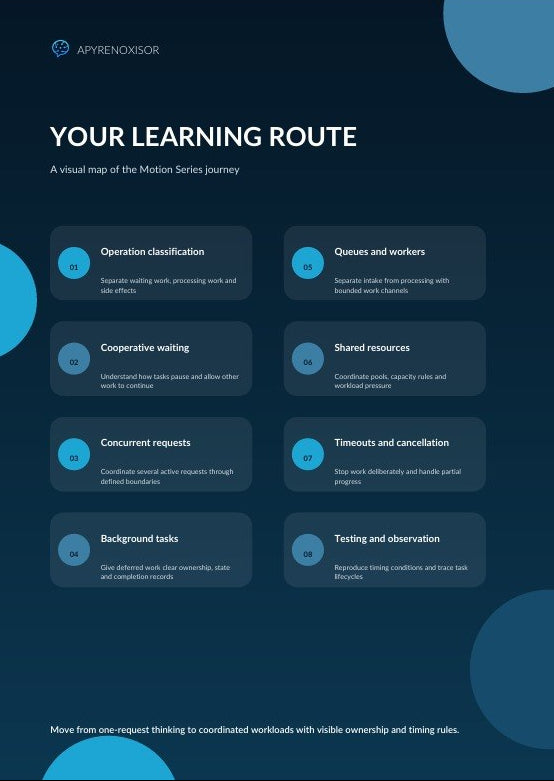
The Motion Series includes comprehensive lessons, practical exercises, planning resources, workflow diagrams, and a guided application project.
Each section explains how tasks move through the application and how responsibilities can remain organized when several processes are active.
Who Is This For?
The Motion Series is intended for learners who understand structured API architecture, database workflows, dependencies, testing, logging, and communication between connected systems.
It may suit developing programmers, technical students, independent learners, and team members who want to explore how API applications coordinate multiple operations.
Learners who completed the Drift Guide can use this tier to continue from integration design into broader workload and task-management concepts.
What You’ll Learn
- Compare synchronous and asynchronous workflows
- Explain how concurrent requests are processed
- Identify operations that involve waiting
- Plan tasks outside the immediate response cycle
- Separate background work from route responsibilities
- Describe task queue concepts
- Manage shared application resources
- Explain connection pool behavior
- Apply request time limits
- Handle task cancellation concepts
- Plan repeated application tasks
- Introduce rate-control rules
- Organize background error handling
- Trace activity across related tasks
- Test concurrent request scenarios
- Review workload behavior through application records
- Identify resource bottlenecks
30-Day Refund Policy
A refund request may be submitted within 30 days of purchase. Requests are reviewed according to the refund terms presented during enrollment and the relevant order information.
Certification
The course include a certificate of completion, giving learners a clear way to confirm their progress and showcase their achievement.
How are the Apyrenoxisor courses structured?
How are the Apyrenoxisor courses structured?
Each tier is divided into focused lessons, guided explanations, practical examples, and review activities. Topics are arranged in a clear order so learners can study foundational concepts before moving toward broader API development tasks.
Do I need previous development experience?
Do I need previous development experience?
Entry requirements vary by tier. Introductory tiers explain core terminology and basic development ideas, while later tiers explore more detailed architecture, testing, documentation, and application organization. Each course description identifies the intended learning stage.
How long can I use the course materials?
How long can I use the course materials?
The materials remain available according to the terms shown at the time of enrollment. Learners can review lessons, revisit examples, and repeat activities at a pace that suits their schedule.